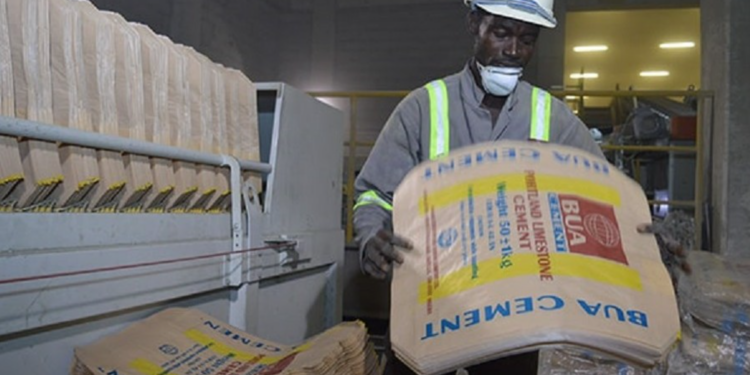

The Nigerian cement industry witnessed a surge in revenue in 2024, with Dangote Cement, BUA Cement, and WAPCO (Lafarge Africa) all reporting impressive financial performances in 2024.
However, beneath the surface of these soaring numbers lies a crucial question: Is this growth driven by genuine expansion in production and sales, or are cement makers simply capitalizing on higher prices?
A closer look at their production capacity, utilization rates, and sales volumes may reveal the true story.
Revenue vs. production volume: Price-driven or organic growth?
In 2024, the three cement companies recorded a combined revenue of N5.154 trillion, marking an impressive 68% YoY growth.
Dangote Cement, the industry leader, contributed N3.58 trillion (+62% YoY), while BUA Cement followed with N876 billion (+90.54% YoY), and WAPCO posted N696.758 billion (+72% YoY).
However, looking at production volumes, the story shifts.
- Dangote Cement has an installed capacity of 52 million tons, yet its production volume increased only slightly from 26.68 million tons in 2023 to 26.96 million tons in 2024, a mere 1% growth.
- BUA Cement expanded its installed capacity from 11 million tons to 17 million tons with two new production lines. Its production volume rose from 6.71 million tons to 8.137 million tons (+21% YoY), bringing its capacity utilization to about 47.9%.
However, management noted that the new capacity wasn’t fully optimized in 2024, meaning the actual sales impact will be clearer in 2025.
- WAPCO’s production capacity and volume remain undisclosed, but given its 72% revenue growth, it is plausible to infer that price increases played a substantial role in its revenue jump.
The disparity between revenue growth and production volume suggests that the industry’s strong top-line performance is largely price-driven.
- Dangote Cement’s marginal volume growth (+1%) versus 62% revenue growth indicates that price hikes significantly boosted earnings rather than increased market demand.
- BUA Cement’s 21% volume growth supports some organic expansion, but with 90.54% revenue growth, pricing adjustments were the main driver.
- WAPCO’s revenue growth with no disclosed production volume suggests a pricing-led strategy.
Market implications: pricing power or monopoly dynamics?
- Cement manufacturers appear to be leveraging their dominant market positions to adjust prices upward, passing costs onto consumers.
- The limited expansion in production volumes despite rising demand raises concerns about the industry’s monopolistic structure, where a few players dictate market pricing.
- This trend has inflationary implications, affecting housing, infrastructure projects, and general construction costs, which may slow economic activities in these sectors.
Turning revenue into profits: Who is more efficient?
While all three cement giants experienced strong revenue growth in 2024, their ability to translate this into profits varied significantly.
The pre-tax profit margins provide a clear picture of how well each company is managing costs.
Dangote Cement: The Giant losing some grip
- Revenue: N3.58 trillion (+62% YoY)
- Pre-tax Profit: N732.537 billion (+32.44% YoY)
- Pre-tax Profit Margin: 20.46% (-18.22%)
Despite its dominant market position, Dangote Cement saw a significant 18.22% decline in pre-tax profit margin, indicating that rising costs likely driven by input prices, finance costs, and foreign exchange losses outpaced revenue growth.
The company remains the most profitable in absolute terms, but declining margins suggest pricing power alone was not enough to shield profitability.
BUA Cement: Expansion comes at a cost
- Revenue: N876.470 billion (+90.54% YoY)
- Pre-tax Profit: N99.630 billion (+48.20% YoY)
- Pre-tax Profit Margin: 11.37% (-22.22%)
BUA Cement posted the highest revenue growth at 90.54% YoY, largely driven by price increases and its capacity expansion from 11 million tons to 17 million tons.
However, the pre-tax profit margin dropped sharply by 22.22%, the steepest decline among the three. This suggests that higher operating costs, increased borrowing costs, eroded profitability. BUA Cement recorded the highest growth in cost of sales at 109% YoY
WAPCO: The surprise winner in efficiency
- Revenue: N696.758 billion (+71.83% YoY)
- Pre-tax Profit: N152.265 billion (+93.27% YoY)
- Pre-tax Profit Margin: 21.85% (+12.48%)
Unlike Dangote and BUA, WAPCO managed to improve its profitability, with a 12.48% increase in pre-tax profit margin to 21.85%, making it the most efficient in converting revenue into profit.
This suggests better cost control, possibly lower debt exposure. WAPCO recorded the lowest interest expenses and foreign exchange loss.
Who is returning the most to shareholders?
While revenue and profit growth are important, investors ultimately care about returns, how efficiently these companies generate profits and reward shareholders. Let us break it down using return on equity (ROE), dividend yield and total shareholders’ return.
Return on Equity (ROE): Who is generating the most shareholder value?
- Dangote Cement: 23.14% (down 12.36% YoY), still the highest.
- WAPCO: 19.84%, relatively good
- BUA Cement: 19.02%, lowest in the group.
Dividend yield & total return: who is rewarding investors?
- Dangote Cement: 6.25% dividend yield, 6.50% total return.
- WAPCO: 1.63% dividend yield, 7.81% total return (Highest in the group).
- BUA Cement: 2.15% dividend yield, 2.15% total return (Lowest).
The numbers suggest that 2024’s revenue surge was more about higher cement prices than actual industry expansion. While WAPCO proved the most efficient in managing costs and rewarding investors, the sector’s pricing-driven growth model raises concerns about long-term sustainability, affordability, and potential regulatory scrutiny.