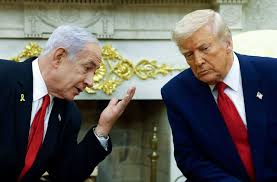

In what may prove to be a defining moment in Middle Eastern geopolitics, Israeli Prime Minister Benjamin Netanyahu has congratulated former U.S. President Donald Trump after coordinated U.S. military strikes on three key Iranian nuclear sites—Fordo, Natanz, and Isfahan—calling the attacks “bold” and “historic.”
“Congratulations President Trump. Your bold decision to target Iran’s nuclear facilities with the awesome and righteous might of the United States will change history,” Netanyahu said in a video address on Sunday.
He described the operation as a “pivot of history” and a step toward lasting peace in the region.
“President Trump and I often say, peace through strength. First comes strength, then comes peace,” he added.
Netanyahu also revealed that the strikes were carried out in close coordination with Israel, suggesting deep military and intelligence collaboration between the two longtime allies.
Earlier, Trump had confirmed the assault via his social media platform, stating that the targeted facilities were central to Iran’s alleged nuclear weapons program. The U.S. joins Israel’s military campaign, which began June 13, when Tel Aviv claimed Iran was days away from developing a nuclear warhead—an allegation Tehran continues to deny.
A historical context: Decades of shadow conflict
The latest strikes are not an isolated event but part of a broader, decades-long confrontation between Iran, Israel, and the United States.
Tensions date back to 1979, when Iran’s Islamic Revolution overthrew the U.S.-backed Shah and established a theocratic regime that openly opposed both Washington and Tel Aviv. The hostage crisis at the U.S. Embassy in Tehran marked the beginning of a long period of hostility.
Since then, relations between the U.S. and Iran have oscillated between tense diplomacy and open confrontation. In 2002, revelations about Iran’s undeclared nuclear sites sparked global alarm. That led to years of negotiations culminating in the 2015 Iran Nuclear Deal (JCPOA), brokered under the Obama administration. The deal imposed strict limits on Iran’s nuclear activities in exchange for sanctions relief.
But in 2018, President Trump unilaterally withdrew the U.S. from the JCPOA, calling it “a horrible, one-sided deal.” That decision reignited tensions, with Iran resuming enrichment activities and the U.S. ramping up sanctions and military pressure.
Israel, under Netanyahu’s leadership, has always opposed the JCPOA and repeatedly warned that Iran’s nuclear program was a threat to its existence. Over the years, Israel has been linked to cyberattacks, targeted assassinations of Iranian nuclear scientists, and sabotage efforts aimed at slowing Iran’s nuclear progress.
A pivot point or a powder keg?
With this new wave of U.S. military involvement, Netanyahu says history is being made—but the consequences are yet unknown.
The strikes may have set back Iran’s nuclear ambitions, but they have also increased the likelihood of a wider regional war. Iran has a web of allies and proxy groups—such as Hezbollah in Lebanon and militias in Iraq and Syria—who could retaliate against U.S. or Israeli targets.
While Netanyahu frames the attack as a step toward peace, the reality is more complex. Peace through strength, a mantra both he and Trump often invoke, carries the risk of spiraling into a prolonged conflict—especially when diplomacy is sidelined.
Opinion: Strength without strategy?
From a political standpoint, both Trump and Netanyahu may gain from the optics of a decisive military strike. But strength without a strategic diplomatic pathway often leaves a vacuum—one that extremist elements are eager to fill.
Iran has vowed revenge. The question is not if, but when and how.
The Middle East has seen such cycles before—where perceived victories quickly dissolve into long, costly wars. Whether this moment is a “pivot of history” or the start of another tragic chapter will depend on what follows: dialogue or escalation, diplomacy or destruction.
For now, the world watches with bated breath.